
Britsino Casino Cashback: How the Mechanic Works, What Gets Returned, and Where the Catch Hides
 Available in GB

I spent three weeks tracking my net losses across four offshore casinos to test whether cashback offers actually returned what the marketing promised. The short answer: not once did the headline percentage match the effective return I received. Cashback is one of those mechanics that sounds straightforward — lose money, get some back — but the gap between the concept and the execution is where operators make their margin. At Britsino Casino, cashback functions as a percentage rebate on net losses calculated over a defined period, and the details buried in the terms reshape what that percentage actually means in pounds.
The UK’s black market for online gambling reached an estimated £16.6 billion in 2025, and cashback has become one of the primary retention tools offshore operators use to keep players cycling funds through their platforms. This article dissects how Britsino’s cashback calculation works, what qualifies as an eligible loss, and the wagering conditions that sit between the rebate and your bank account.
The Cashback Calculation: Net Losses, Eligible Bets, and the Reporting Window
Last year a reader forwarded me a cashback statement from an offshore casino that showed a 15 per cent rebate on paper but delivered roughly 6 per cent in effective value after exclusions. That ratio is not unusual, and it stems from how “net losses” are defined in the operator’s terms rather than in the player’s mental model.

Britsino calculates cashback on net losses within a specific reporting window — typically weekly. Net losses means total deposits minus total withdrawals minus any bonus funds received during that period. If you deposited £500, withdrew £200, and received £50 in bonus funds, your net loss for cashback purposes is £250, not £300. The bonus deduction is the detail most players miss, and it reduces the cashback base by the full value of any promotional credit received, regardless of whether you managed to convert that credit into withdrawable cash.
The percentage applied to that net loss figure varies by player tier. Standard players receive a lower percentage; VIP or loyalty programme members receive higher rates. I have seen cashback percentages at comparable Curaçao-licensed operators range from 5 per cent at the base tier to 15 per cent or higher for high-volume players. The specific tiers and percentages at Britsino are defined in the VIP and loyalty programme structure, which I have analysed separately.
One mechanical detail worth noting: cashback is calculated at the end of the reporting window, not in real time. If you deposit £1,000 on Monday, lose £800 by Wednesday, and then win £600 on Thursday, your net loss for the week is £200, not £800. The Thursday recovery reduces your cashback base. This is fair from an accounting standpoint but means cashback is not a safety net during a losing streak — it is a retrospective rebate that only materialises after the window closes.
What Counts and What Does Not: Game Eligibility and Exclusions
Have you ever claimed a cashback rebate only to discover that half your session did not count toward the calculation? I have, and it happened because the games I was playing fell outside the eligible category. This is not a Britsino-specific issue — it is an industry pattern — but the specifics matter because they determine whether your actual playing behaviour generates a cashback return.
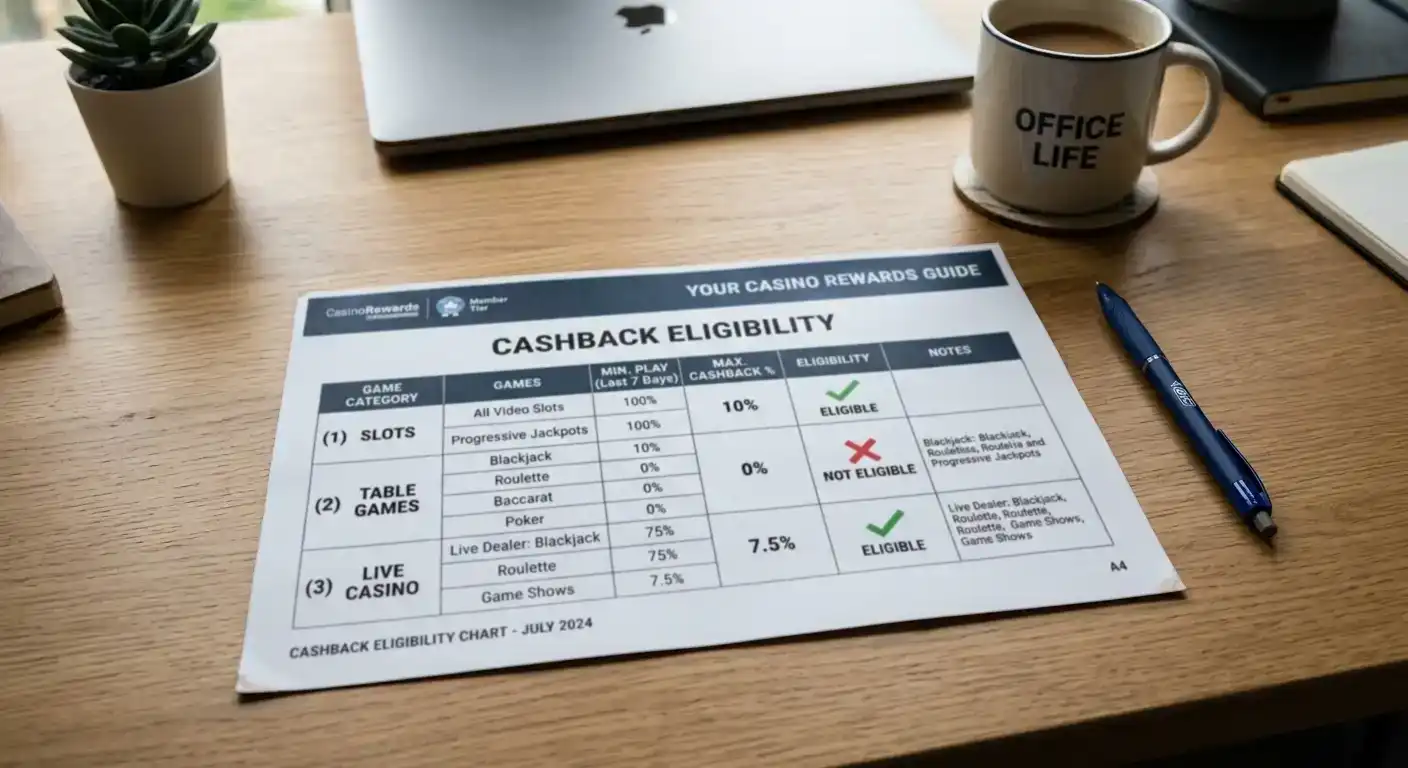
Slots typically count at 100 per cent toward cashback calculations, mirroring their full contribution to wagering requirements. Table games — blackjack, roulette, baccarat — are either weighted at a reduced percentage or excluded entirely. The logic from the operator’s perspective is the same as with bonus wagering: table games carry a lower house edge, so full cashback on table game losses would cost the operator disproportionately more per pound wagered. The average online slot session generates £3.82 in gross gaming yield per 15-minute window with 124 spins, and that yield margin is what funds the cashback programme.
Live dealer games occupy a grey area. Some operators include them in cashback calculations at the same reduced weighting as RNG table games; others exclude them entirely. Britsino’s terms specify which categories qualify, and I recommend checking the current cashback promotion page before assuming your preferred game type is covered. A session of live blackjack that generates a £200 loss might yield zero cashback if the category is excluded — a £200 surprise that no one warns you about at the table.
Bets placed with bonus funds are universally excluded from cashback calculations. Only losses from real-money wagers count. This creates a sequencing consideration: if you activate a bonus and play through it before switching to real-money play, only the losses incurred after the bonus funds are exhausted contribute to your cashback total. Players who mix bonus and real-money play within the same session may find the attribution opaque, since the operator’s system determines which funds were used for each bet.
Wagering Requirements on Cashback Credits
The most important question about any cashback offer is not the percentage — it is whether the rebate arrives as withdrawable cash or as bonus funds with strings attached. I have audited dozens of cashback programmes, and the split is roughly 60/40 in favour of bonus-fund cashback across the offshore tier. Roughly 48 per cent of UK adults engage in some form of gambling each month, and the retention mechanics designed to keep them active are becoming progressively more layered.

At Britsino, cashback credits are subject to their own wagering requirement before withdrawal. The multiplier is typically lower than the welcome bonus playthrough — x5 to x10 is common for cashback, compared to x40 for deposit match bonuses — but it is not zero. A x5 wagering requirement on a £25 cashback credit means you need to wager £125 before the £25 converts to withdrawable funds. At 96 per cent RTP, the expected cost of that wagering is £5, reducing your effective cashback from £25 to roughly £20. The percentage on the marketing page said 10 per cent; the effective return after wagering cost is closer to 8 per cent.
Some operators offer “wager-free” cashback at their highest VIP tiers, meaning the rebate arrives as real money with no playthrough attached. This is the gold standard for cashback value, and it is reserved for players whose volume justifies the cost to the operator. If Britsino offers wager-free cashback at any tier, it will be explicitly stated in the VIP terms — and its absence at lower tiers should be assumed unless the terms say otherwise.
Maximum withdrawal caps on cashback winnings are another variable. Even after clearing the wagering requirement, the amount you can withdraw from cashback-derived funds may be capped. A £25 cashback credit with x5 wagering and a £100 withdrawal cap means that even if your wagering session produces a £500 balance, you can extract £100 at most. The remaining £400 is forfeit.
When Cashback Delivers Real Value and When It Does Not
After seven years of tracking cashback programmes across offshore and regulated operators, I have a simple heuristic: cashback is worth paying attention to only if you would be playing the same games at the same stakes without it. Adjusting your play to chase a cashback rebate — increasing stakes, extending sessions, or switching to unfamiliar games — is the fastest way to turn a 10 per cent rebate into a net-negative outcome.
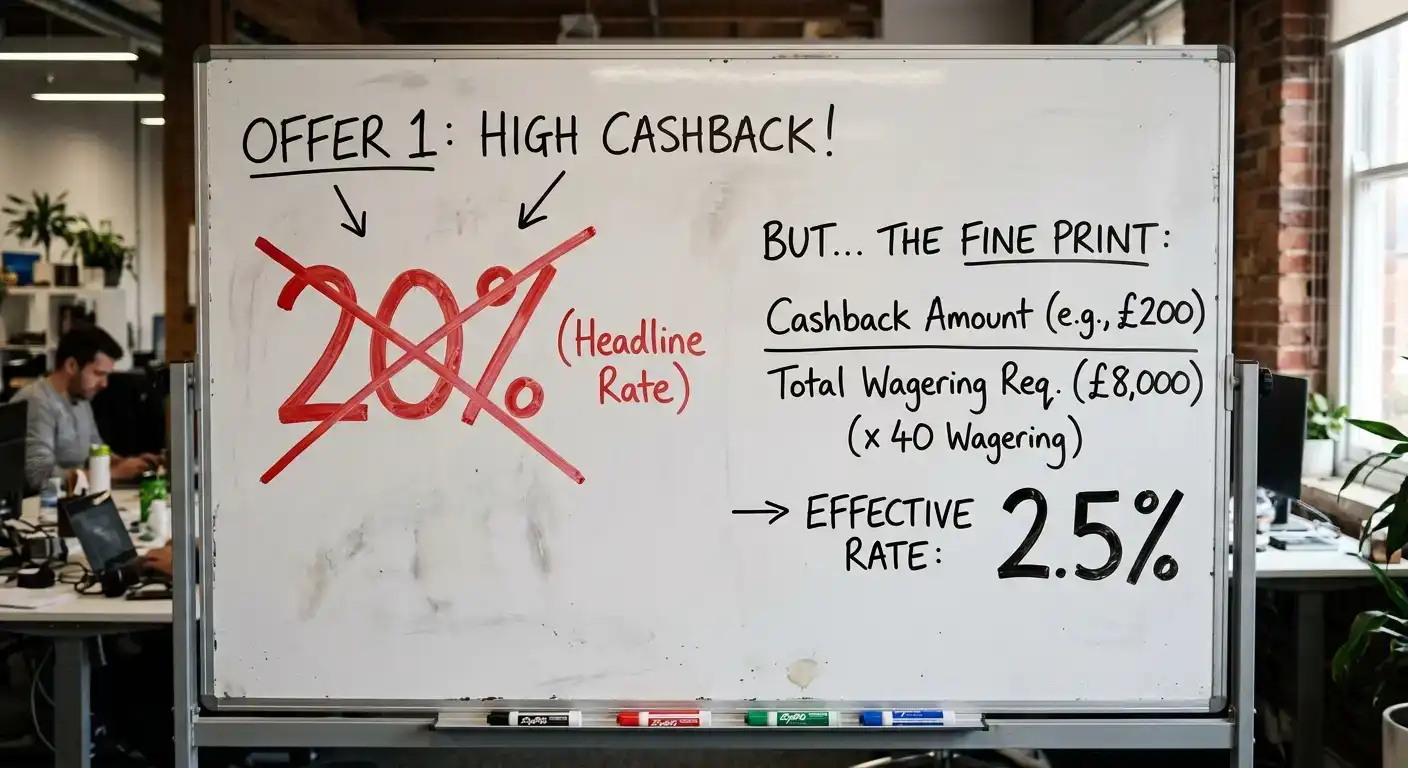
The maths is clear. If your natural playing pattern produces £500 in net losses per month and the cashback rate is 10 per cent with x5 wagering, your effective monthly rebate is roughly £40 after wagering costs. That is £40 against £500 in losses — an 8 per cent effective reduction, not the 10 per cent headline. It reduces the cost of entertainment but does not fundamentally change the economic equation. The crypto-gambling market exceeded $65 billion in global volume in 2026, and cashback is one of the mechanisms that keeps that volume circulating.
Where cashback does deliver genuine value is at the VIP tier where wager-free rebates are available. A wager-free 15 per cent cashback on £1,000 in net losses returns £150 in real money — no strings, no wagering, no cap ambiguity. That is a meaningful reduction in effective house edge, and it is the primary financial incentive that high-volume players cite when choosing between competing operators. For recreational players at standard tiers, cashback is a minor cushion, not a strategy.

Is Britsino Casino cashback paid as real money or bonus funds?
Cashback at Britsino is typically credited as bonus funds subject to a wagering requirement before withdrawal. The wagering multiplier for cashback is usually lower than for deposit bonuses — commonly x5 to x10. Wager-free cashback may be available at higher VIP tiers, but this should be confirmed in the current programme terms.
Do table game losses count toward Britsino cashback?
Table games are commonly weighted at a reduced percentage or excluded from cashback calculations at Britsino. Slots typically count at 100 per cent. Check the specific cashback promotion terms for the current game eligibility schedule, as coverage varies between promotional periods.
Written by the editors at Britsino Casino.