
Britsino Casino No-Deposit Bonus: What Free Money Actually Costs You
 Available in GB

A few years ago, I claimed a £10 no-deposit bonus at an offshore casino, played it into £87 over two hours of unusually lucky roulette, and then spent the next three days discovering why that £87 would never reach my bank account. The wagering requirement was x60, the maximum withdrawal was capped at £50, and the bonus expired before I could meet the playthrough. The “free” £10 cost me nothing financially — but it cost me time, attention and a fair amount of frustration. That story is more common than the industry would like you to believe.
No-deposit bonuses occupy a peculiar space in casino marketing. They are the closest thing to genuinely free money the gambling industry offers — and simultaneously the most conditional, restricted and mathematically hostile promotional format in existence. At Britsino Casino, as at any offshore platform, the question is not whether a no-deposit bonus exists but whether its terms make it worth engaging with at all.
How No-Deposit Bonuses Actually Work
Imagine someone hands you a £10 note on the street with one condition: you can only spend it at a specific shop, and you can only keep the change if you first spend £600 of your own money at that same shop. Would you consider that £10 “free”? That is essentially the mechanics of a no-deposit bonus with a x60 wagering requirement — and many players do not see through the framing until they try to withdraw.
The basic structure is straightforward. A casino credits a small amount — typically £5 to £25, or a set number of free spins — to your account upon registration, before you make any deposit. You can use this credit to play real games and generate real winnings. However, those winnings are classified as “bonus funds” subject to wagering requirements, maximum bet limits, game restrictions, withdrawal caps, and time limits. Each of these conditions independently reduces the expected value of the bonus. Together, they often reduce it to near zero.
The UK Gambling Commission’s 2025 enforcement data shows that misleading bonus terms remain one of the most common consumer complaints in the gambling sector — accounting for approximately 23% of all player disputes filed with alternative dispute resolution services. No-deposit bonuses generate a disproportionate share of these complaints because the gap between perceived value (“free £10”) and actual value (often under £0.50 in expected withdrawable funds) is wider than for any other bonus type.
The Wagering Requirement Calculation
I once sat down with a spreadsheet and calculated the expected value of every no-deposit bonus I had claimed over two years. The results were sobering. Of fourteen no-deposit bonuses totalling £155 in credited bonus funds, I successfully withdrew exactly £0 from twelve of them and a combined £34 from the remaining two. My effective return on “free” money was 22% — and I had spent roughly forty hours of playing time generating it.
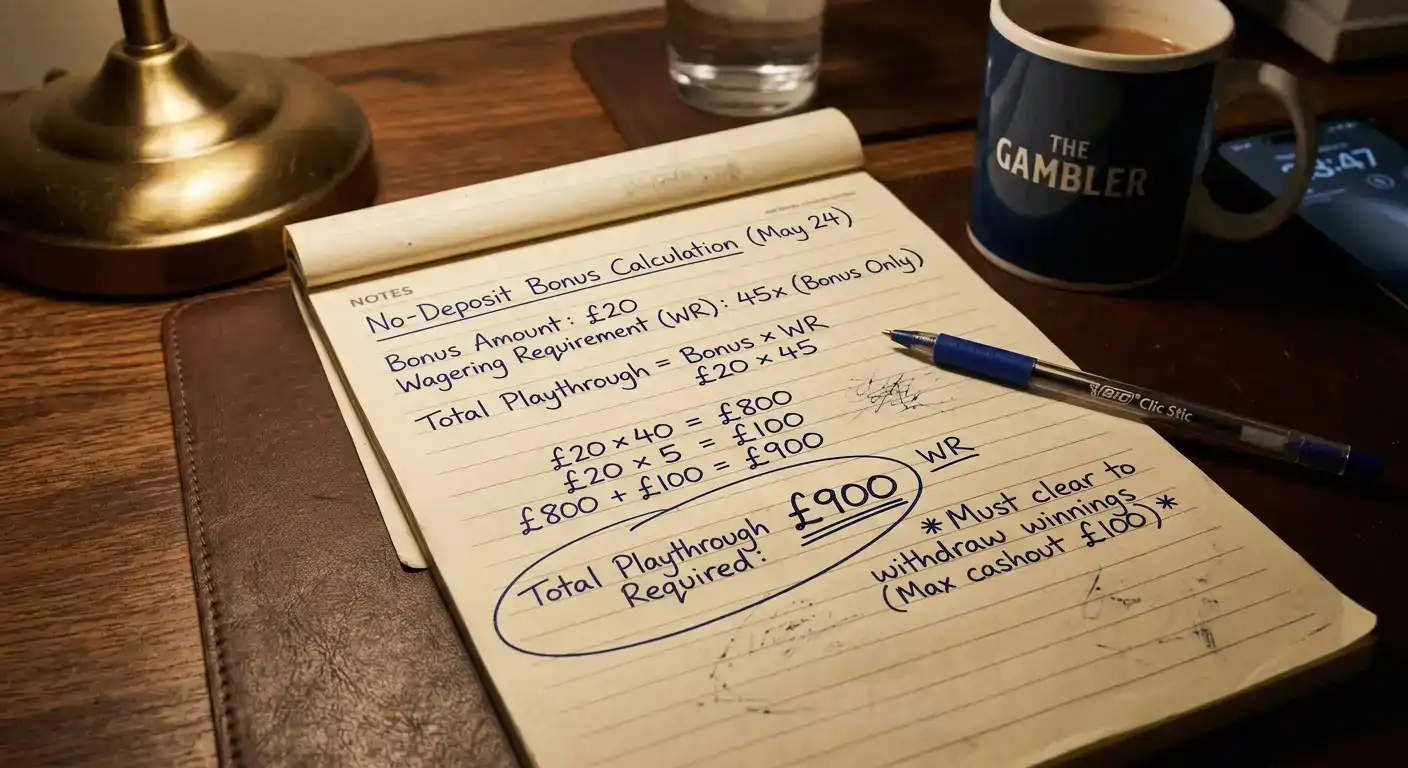
The maths behind this is not complicated but it is unforgiving. Take a £10 no-deposit bonus with a x40 wagering requirement. You must wager £400 total before any winnings become withdrawable. If you are playing a slot with 96% RTP, your expected loss per £100 wagered is £4. Over £400 in wagers, your expected loss is £16 — more than the bonus itself. Mathematically, you are expected to lose the entire £10 bonus plus £6 of any winnings before you complete the requirement.
Higher wagering multipliers make this worse. At x60, you must wager £600 on a £10 bonus, with an expected loss of £24 on a 96% RTP game. At x80, the expected loss hits £32. The bonus does not just fail to deliver value — it creates a mathematical scenario where completing the requirement almost certainly eliminates all winnings. This calculation is explored more thoroughly in the wagering requirements deep dive, but the core principle applies with even more force to no-deposit bonuses because the starting balance is so small.
Maximum Withdrawal Caps and Their Hidden Impact
Even if you beat the mathematical odds and clear the wagering requirement with money left — which does happen, just rarely — you encounter the second layer of value restriction: the maximum withdrawal cap. Most no-deposit bonuses limit the amount you can withdraw from bonus-generated winnings, typically between £20 and £100. Any amount above the cap is forfeited, regardless of how much you won.

This cap fundamentally changes the risk-reward profile of how you should play. Without a cap, high-volatility games make mathematical sense — the large occasional wins compensate for frequent losses. With a cap, any win above the maximum is wasted. A £500 jackpot on a no-deposit bonus with a £50 cap is worth exactly as much as a £50 win — all the excess evaporates. This effectively eliminates the appeal of high-volatility slots and progressive jackpots, which are typically the only games capable of generating returns large enough to survive the wagering requirement.
The interaction between wagering requirements and withdrawal caps creates a mathematical corridor that is extremely narrow. You need to win enough to survive the expected losses from wagering, but not so much that your winnings exceed the cap. The ideal outcome is a series of small, consistent wins — which is precisely the outcome that high-volatility slots are designed not to deliver.
Game Restrictions and Contribution Rates
Not all games count equally toward wagering requirements, and no-deposit bonuses typically impose the strictest game weighting of any bonus type. Slots generally contribute 100% — every £1 wagered counts as £1 toward the requirement. Table games might contribute 10% to 20%, meaning a £1 blackjack bet counts as only £0.10 to £0.20. Some games are excluded entirely.
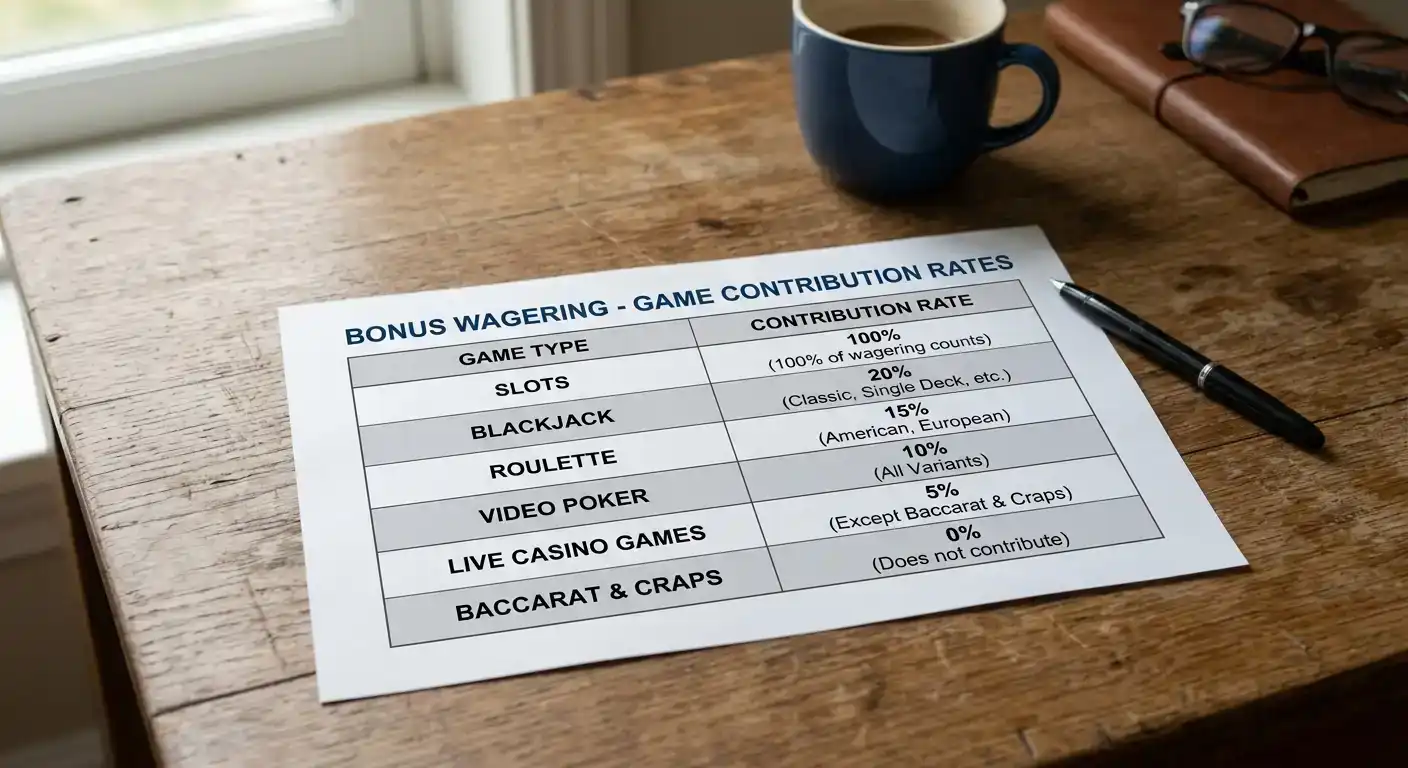
These restrictions are not arbitrary. They reflect the house edge differential between game types. Blackjack with optimal strategy has a house edge below 0.5%, which means a player could theoretically clear wagering requirements while losing very little. Restricting blackjack contribution forces players toward slots, where the house edge is typically 3% to 6% — ensuring the wagering requirement extracts maximum value from the bonus.
At Britsino, bonus terms should specify which games qualify and at what contribution rate. Check this before you play — not after you have wagered £200 on a game that contributes 0%. That scenario happens more often than you would expect, and the result is wasted time with no progress toward meeting the playthrough requirement.
Time Limits and the Pressure to Play
There is an uncomfortable psychological dimension to no-deposit bonuses that rarely gets discussed. Most impose an expiry window — typically 7 to 14 days — within which you must complete the wagering requirement or forfeit both the bonus and any winnings. This creates artificial urgency that pushes players toward longer, faster sessions than they would otherwise choose.

Consider the maths of a £10 bonus with x40 wagering and a 7-day expiry. You need to wager £400 within a week. At £1 per spin, that is 400 spins — achievable in a couple of hours. But at higher stakes, which the terms might cap at £5 maximum bet, you complete the requirement faster while also increasing variance. The time pressure nudges you toward the maximum allowed bet size, which is precisely the stake level most likely to empty your bonus balance before the requirement is met.
The UKGC has flagged time-limited bonus structures as a concern in its ongoing review of gambling harm indicators. While Britsino operates outside UKGC jurisdiction, the psychological dynamic remains identical — a countdown timer creates urgency, and urgency leads to decisions that favour the house. Per the UK Gambling Commission’s Gambling Survey for Great Britain (Year 2, 2024), 48 per cent of UK adults aged 18+ gambled in the past four weeks. Promotional urgency is one of the mechanisms that drives engagement intensity beyond intended levels.
When a No-Deposit Bonus Is Worth Claiming
After everything I have outlined, you might assume I never claim no-deposit bonuses. That is not quite true. I claim them selectively, with clear criteria that determine whether the terms cross the threshold from “mathematically pointless” into “entertainingly marginal.”
A no-deposit bonus is worth considering when the wagering requirement is x30 or below, the maximum withdrawal is at least £100, the time limit is 14 days or more, and slots contribute 100%. Meeting all four criteria is uncommon — most no-deposit bonuses fail on at least two. But when the conditions align, the expected value of the bonus shifts from negligibly negative to slightly positive, and the entertainment value of playing with no financial risk tips the equation further.
The key mindset shift is treating the no-deposit bonus as entertainment with a small chance of profit, not as a genuine income opportunity. If claiming and playing a no-deposit bonus feels like work — tracking playthrough progress, monitoring time limits, calculating optimal stakes — the expected return does not justify the effort. Play if it is fun. Stop if it is not. The moment a “free” bonus starts feeling like an obligation, it has already cost you more than it was ever worth.
Reading the Terms Before the Balance
The single most valuable skill in casino bonus evaluation has nothing to do with game strategy or mathematical modelling. It is reading. Specifically, reading the full bonus terms and conditions before claiming — not after, not halfway through, not when you try to withdraw and discover a clause you missed.

Look for five specific data points: the wagering multiplier, the maximum withdrawal cap, the time limit, the game contribution percentages, and the maximum bet size during wagering. If any of these are absent from the terms, treat that absence as a red flag — not because the operator is necessarily acting in bad faith, but because ambiguous terms always resolve in the house’s favour when a dispute arises.
Write the numbers down. Compare them to the expected value calculation. Make a conscious decision about whether the terms warrant your time and attention. This process takes five minutes and transforms you from a player who reacts to bonuses into one who evaluates them. The casino designed the bonus to be claimed impulsively. Refusing to be impulsive is, in this context, a genuine competitive advantage.
Does Britsino Casino offer a no-deposit bonus for new players?
No-deposit bonus availability varies and depends on current promotions. Check Britsino’s promotions page or registration process for any active no-deposit offers. Always read the full terms — particularly the wagering requirement, maximum withdrawal cap, and time limit — before claiming.
What is a realistic expected value from a no-deposit bonus?
For a typical £10 no-deposit bonus with x40 wagering on 96% RTP slots, the expected loss during wagering is approximately £16 — exceeding the bonus itself. This means the mathematical expected value of withdrawing profit is negative. Only bonuses with low wagering multipliers (x30 or below) and high withdrawal caps (£100 or more) offer marginally positive expected value.
Should I use high-volatility or low-volatility slots for no-deposit bonus wagering?
Low-to-medium volatility slots are generally better suited for no-deposit bonus play. High-volatility games can produce large wins, but withdrawal caps mean any win above the maximum is forfeited. Low-volatility games deliver smaller, more consistent returns that are better aligned with the narrow mathematical corridor needed to clear wagering requirements while staying under the cap.
Created by the ”Britsino Casino” editorial team.