
Britsino Casino Affiliate Programme: Commission Models, Terms and What Partners Should Know
 Available in GB

My first affiliate commission payment in the iGaming industry was £14.30. It arrived six weeks after I published a review article that took twelve hours to write, and I remember thinking — with considerable self-awareness — that I had just earned roughly £1.19 per hour. Five years later, I understand why experienced affiliates describe the first six months as the “reality filter” that separates people who understand compounding traffic from people who expect instant returns. The affiliate business is not quick money. It is a publishing operation with casino-adjacent economics.
Britsino Casino operates an affiliate programme that follows the structural patterns common across Curaçao-licensed operators. Understanding how these programmes work — from commission mechanics to the fine print that can erase your earnings — is essential for anyone considering a partnership. This article breaks down the model from the partner side, explaining what the numbers mean and where the traps hide.
Table of Contents
- Revenue Share vs CPA: Two Fundamentally Different Bets
- Net Revenue Calculations and the Deductions That Matter
- Negative Carryover: The Clause That Can Zero Your Earnings
- Cookie Duration, Attribution and Tracking Integrity
- Content Requirements and Compliance Obligations
- Evaluating Whether a Programme Merits Your Traffic
Revenue Share vs CPA: Two Fundamentally Different Bets
Choosing between revenue share and CPA is the most consequential decision an affiliate makes, and most people get it wrong because they optimise for the wrong variable. CPA — cost per acquisition — pays a fixed amount for each depositing player you refer. Revenue share pays a percentage of the net revenue that player generates for the casino, typically for the lifetime of the player’s account. One is immediate; the other is speculative but potentially far larger.

Here is how the maths plays out in practice. A CPA deal might pay £75 to £200 per depositing player, depending on the operator and your negotiating leverage. You get paid once, regardless of whether that player deposits £20 and never returns or becomes a whale who plays daily for three years. Revenue share, typically set between 25% and 45% of net gaming revenue, pays nothing if the player wins and potentially thousands if the player loses consistently over time.
The choice depends entirely on your traffic profile. If you send high volumes of low-quality traffic — players who deposit once and churn — CPA is more profitable because you capture value from players who would generate minimal long-term revenue. If your traffic is smaller but higher quality — engaged players who return regularly — revenue share compounds dramatically. One player generating £100 per month in net revenue at a 35% share is worth £420 per year, recurring. Ten such players equal £4,200 annually from a single article.
According to SOFTSWISS data on affiliate economics, the average iGaming affiliate programme operates at a blended cost of acquisition between £180 and £340 per first-time depositor across all commission models — a figure that contextualises why operators are willing to pay seemingly generous commissions. The lifetime value of a retained player typically exceeds that cost by a factor of three to five.
Net Revenue Calculations and the Deductions That Matter
I learned this lesson the expensive way: “revenue share” does not mean a share of what players lose. It means a share of net gaming revenue after deductions — and those deductions can be substantial. The standard formula subtracts bonuses awarded, payment processing fees, licensing costs, platform fees and sometimes administrative charges before calculating your commission percentage.
Let me illustrate with real numbers. A player you referred deposits £500 and loses £300 in a month — the casino’s gross gaming revenue from that player is £300. The casino issued a £100 bonus, which comes off the top. Payment processing cost 5%, subtracting £25. A platform fee of 10% removes another £30. Your revenue share is calculated on £145 — less than half the gross revenue. At 35% share, your commission is £50.75, not the £105 you might have expected from 35% of £300.
The specific deductions vary by programme, and this is where reading the affiliate agreement becomes critical. Some programmes deduct aggressively — including costs that other programmes absorb. Others offer “clean” revenue share with minimal deductions, typically compensating with a lower percentage. A 25% share with minimal deductions can actually pay more than a 40% share with heavy deductions. Always ask for the deduction schedule in writing before signing.
Negative Carryover: The Clause That Can Zero Your Earnings
If there is one term in any affiliate agreement that deserves your complete attention, it is the negative carryover clause. This provision determines what happens when a referred player wins big in a given month — generating negative net revenue for the casino and, by extension, negative commission for you.

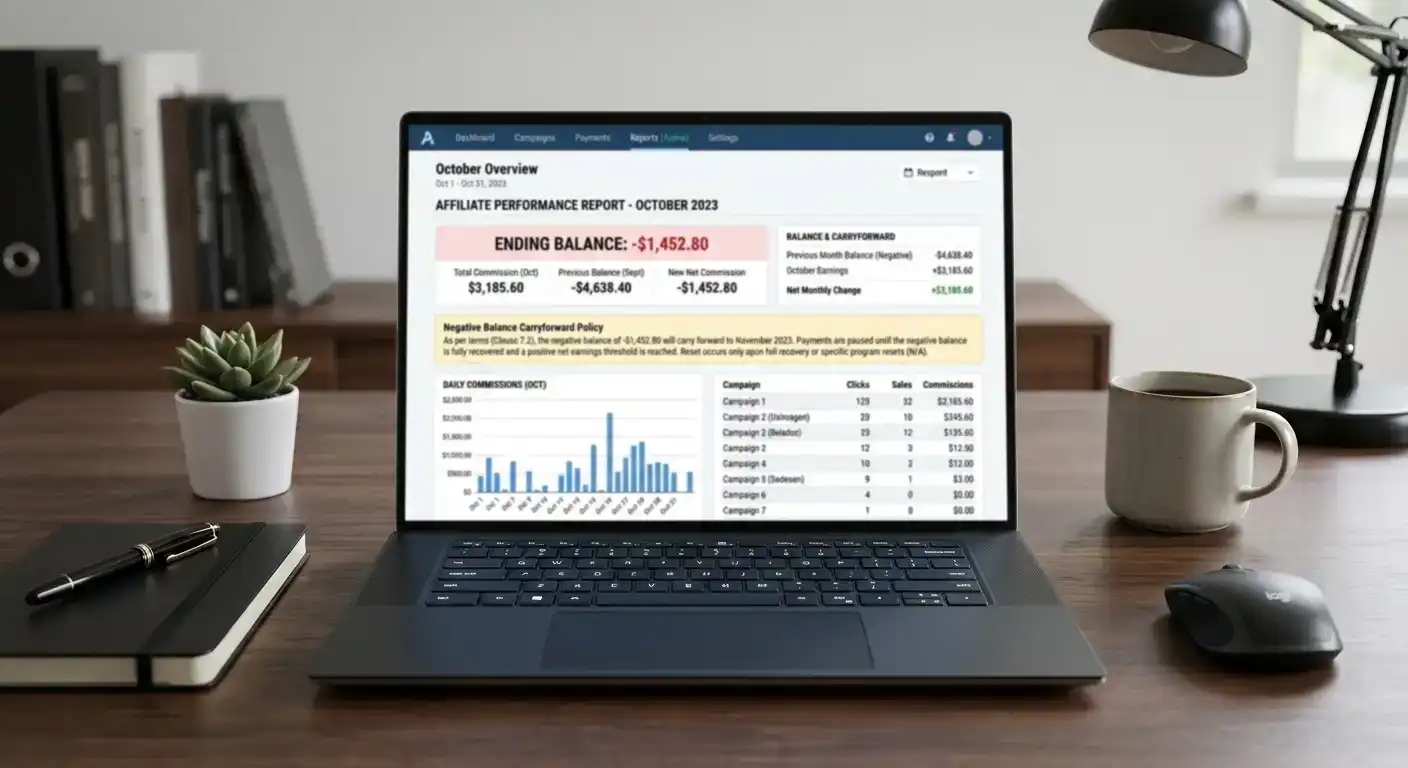
With negative carryover, that deficit rolls into the next month. If your player wins £2,000 in January, creating a -£2,000 balance on your commission account, you earn nothing in February until your referred players collectively generate enough positive revenue to offset the deficit. One lucky player can wipe out months of accumulated commission.
Without negative carryover, each month resets to zero. A player’s big win in January costs you that month’s commission but does not affect February. Your worst-case scenario in any given month is £0, not a debt that must be repaid from future earnings.
The impact on affiliate economics is profound. Under negative carryover terms, a single high-roller who hits a jackpot can create a deficit that takes six months of normal player activity to recover. I have spoken with affiliates who abandoned otherwise profitable partnerships specifically because one player’s win triggered a negative balance they could not mathematically escape without referring dozens of new players. In the UK online gambling market — where quarterly gross gambling yield from slots alone reaches £773 million according to the Gambling Commission — the variance at the player level can be extreme enough to devastate an affiliate’s revenue even on a profitable overall portfolio.
Cookie Duration, Attribution and Tracking Integrity
An affiliate’s business depends entirely on one technical question: when a player you referred makes a deposit, does the system correctly attribute that player to you? The tracking mechanism — typically a browser cookie placed when someone clicks your referral link — determines whether you get paid for the traffic you send.
Cookie durations in iGaming affiliate programmes typically range from 30 to 90 days. A 30-day cookie means that if someone clicks your link today but does not register and deposit until day 31, you receive no commission. They are attributed to whoever’s link they clicked most recently, or to no affiliate at all. Longer cookie durations protect your investment in content that has a delayed conversion path — which describes most informational content. A reader discovers your article, bookmarks the casino, and returns two months later to register. With a 30-day cookie, that conversion is lost.
Beyond duration, the attribution model matters. First-click attribution credits the first affiliate link the player encountered. Last-click attribution credits the most recent. In a landscape where players often read multiple review sites before registering, the attribution model determines which affiliate captures the value. Most iGaming programmes use last-click, which rewards affiliates who capture players at the decision point rather than those who create initial awareness.
Ask the affiliate programme three questions before you sign: what is the cookie duration, what attribution model is used, and how can you independently verify that your tracked clicks are converting at a reasonable rate? If the programme cannot or will not answer these questions clearly, your commission is only as reliable as your trust in their reporting.
Content Requirements and Compliance Obligations
Affiliate partnerships in the gambling industry carry regulatory obligations that affiliates ignore at their peril. Even when the operator holds a Curaçao licence rather than a UKGC licence, affiliates targeting UK players must comply with the Advertising Standards Authority’s gambling advertising codes. Misleading claims, irresponsible promotional language, targeting of minors, and failure to include responsible gambling messaging can all result in enforcement action against the affiliate — not just the operator.

The ASA’s code requires that gambling advertisements — including affiliate content — must not portray gambling as a solution to financial problems, must not suggest that skill can overcome chance in games of pure luck, must not target people under 18, and must include responsible gambling messaging. In 2025, the ASA issued 741 formal notices related to gambling advertising, with a significant proportion targeting affiliate websites and social media content rather than operators directly.
At the content level, this means affiliate articles about Britsino or any other casino must present information factually, avoid exaggerated claims about winning potential, include responsible gambling messaging, and never create urgency around bonus claiming or deposit behaviour. The best affiliate content reads like journalism, not advertising — and that is not just an ethical position. It is a practical one, because search engines increasingly penalise promotional content while rewarding informational depth.
Evaluating Whether a Programme Merits Your Traffic
Not every affiliate programme deserves your audience. Your readers trust your content, and sending them to an operator that treats players poorly damages that trust — which is the only real asset an affiliate owns. Due diligence on the operator is not optional; it is the foundation of a sustainable affiliate business.

Assess the operator on four dimensions. First, player experience: does the casino pay withdrawals reliably, respond to support queries promptly, and maintain a game catalogue from reputable providers? Second, commission terms: are the revenue share deductions reasonable, is negative carryover present, and is the minimum payout threshold achievable? Third, tracking reliability: does the programme provide transparent reporting, and do your tracked clicks align with reasonable conversion expectations? Fourth, longevity: how long has the operator been active, and what is the programme’s reputation among other affiliates?
The iGaming affiliate space generates billions in annual revenue, but that revenue concentrates among affiliates who build lasting relationships with reliable programmes — not those who chase the highest commission percentage without examining the terms beneath it. A 45% revenue share with aggressive deductions, negative carryover and unreliable tracking is worth less than a 30% share with clean terms and consistent payment. Your time is finite. Spend it on partnerships that respect it.
What commission models does the Britsino Casino affiliate programme offer?
Most Curaçao-licensed casino affiliate programmes offer revenue share, CPA, or hybrid models. Revenue share typically ranges from 25% to 45% of net gaming revenue. CPA pays a fixed amount per depositing player. Contact the programme directly for current rates and available models, as terms vary and are often negotiable based on traffic volume.
What is negative carryover in an affiliate programme?
Negative carryover means that if your referred players generate a net loss for the casino in a given month — by winning more than they lose — the resulting negative commission balance carries forward into the next month. You earn no commission until subsequent months of positive revenue offset the deficit. Programmes without negative carryover reset to zero each month, capping your worst-case monthly earnings at zero rather than creating ongoing debt.
Do affiliates promoting offshore casinos to UK players have legal obligations?
Yes. Affiliates targeting UK players must comply with the Advertising Standards Authority’s gambling advertising codes regardless of the operator’s licensing jurisdiction. This includes presenting factual information, avoiding misleading claims about winning potential, not targeting minors, and including responsible gambling messaging. Non-compliance can result in formal ASA enforcement action against the affiliate.
Written by the editors at Britsino Casino.